MPoweredHub logo with blue-green lettering and a curved blue line.
Reading time: about 15 minutes

Creatio 10x Release: How Companies Are Reimagining the Integration of CRM, AI, and No-Code

With the release of Creatio 10x, unveiled on July 15, 2026, Creatio is consistently advancing its platform in this direction. The new version combines personal AI assistants, enterprise-wide AI agents, no-code development, and CRM functions for sales, marketing, and service on a single platform.
This gives B2B companies the opportunity to do more than just speed up individual work steps. Entire customer and business processes can now be reorganized, further automated, and scaled with the help of AI.
An experienced CRM agency therefore does more than just handle the technical setup of software in such projects. It combines strategy, process analysis, data management, integration, and change management into a sustainable overall concept.

Artificial intelligence isn’t just changing the functionality of modern business software; it’s also challenging traditional licensing and pricing models. Many CRM and workflow solutions continue to be billed based on the number of human users. However, as AI agents increasingly take on tasks and support entire process steps, a pure “price-per-user” model no longer accurately reflects actual usage.

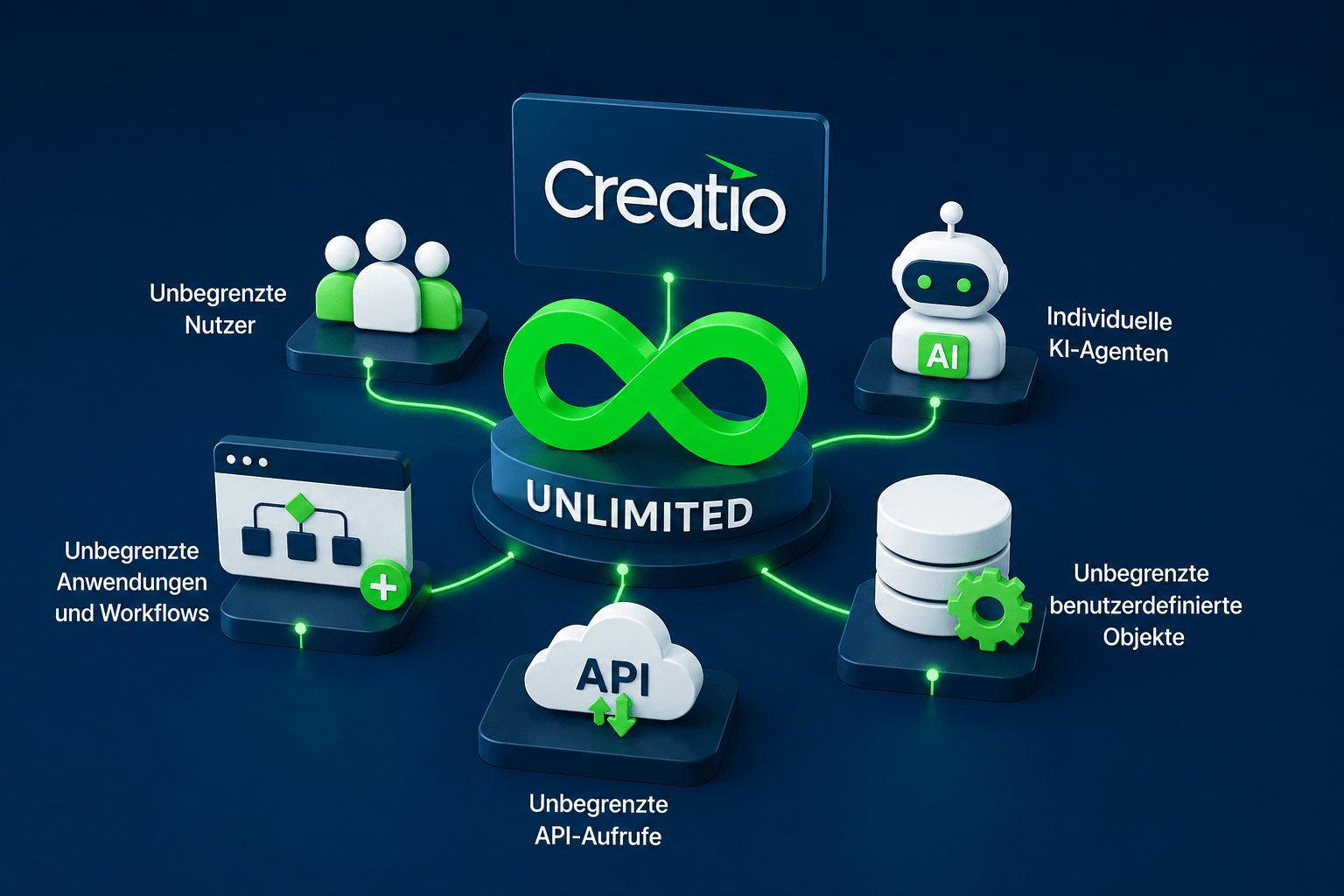
With its new Unlimited Plan, Creatio is responding to this trend. Companies should be able to scale users, applications, workflows, and custom-developed AI agents across the entire organization without having to account for every expansion through additional user licenses.

Even prospective customers searching online for “studio creatio” or “creatio software” will thus encounter an important innovation: Creatio is increasingly evolving from a traditional CRM and workflow solution into a comprehensive platform for AI-powered business processes.

At the heart of this are so-called AI agents. They can analyze information, summarize content, update data records, and execute defined tasks within a business process.
For B2B companies, this opens up new opportunities to bring together CRM, artificial intelligence, and automation on a single platform.

The Most Important Changes at a Glance

Creatio describes 10x as its most comprehensive release to date. At its core is a platform where human-driven and fully agent-based customer processes can be executed in parallel.
Key new features include the personal AI assistant AI Twin, the Creatio AI Studio, visual tools for developing different types of agents, and new features for Creatio Sales, Creatio Marketing, and Creatio Service. The release is complemented by omnichannel capabilities, governance tools, and the Unlimited Enterprise model.
The primary goal: Companies should increase productivity, development speed, and business impact by having employees and AI agents collaborate within the same processes.

The term “10x” refers to the goal of enabling significantly higher performance. Whether a company actually achieves a tenfold improvement, however, depends on the processes selected, the quality of the data, and the specific implementation.

Why Traditional CRM Processes Need to Be Rethought

Traditional CRM systems help employees manage customer data, sales opportunities, marketing campaigns, and service cases. However, many tasks still need to be prepared, reviewed, or documented manually.

Sales representatives research information before customer meetings. Marketing teams create target audiences and campaign content. Service representatives categorize inquiries and search for appropriate solutions. These activities are important but consume a significant portion of available work time.

Creatio 10x addresses this very issue. AI agents can analyze information, prepare tasks, and execute defined process steps. In doing so, they are directly connected to the platform’s CRM data, workflows, and permissions.

The integration of CRM and AI thus evolves from an additional feature into a fundamental platform principle. AI does not operate independently of the CRM but rather within existing customer and business processes.

This results in an AI-powered CRM for companies that provides context-aware support to employees and can take over recurring processes either partially or completely.
Creatio 10x does not, therefore, replace the tried-and-true core functions of a CRM system. The platform expands on these by enabling the direct integration of AI agents into sales, marketing, service, and business processes.

For a CRM marketing agency in particular, this changes the scope of tasks. In addition to campaign management and lead management, agent design, data quality, governance, and process automation are becoming significantly more important.

New Opportunities for Process Automation

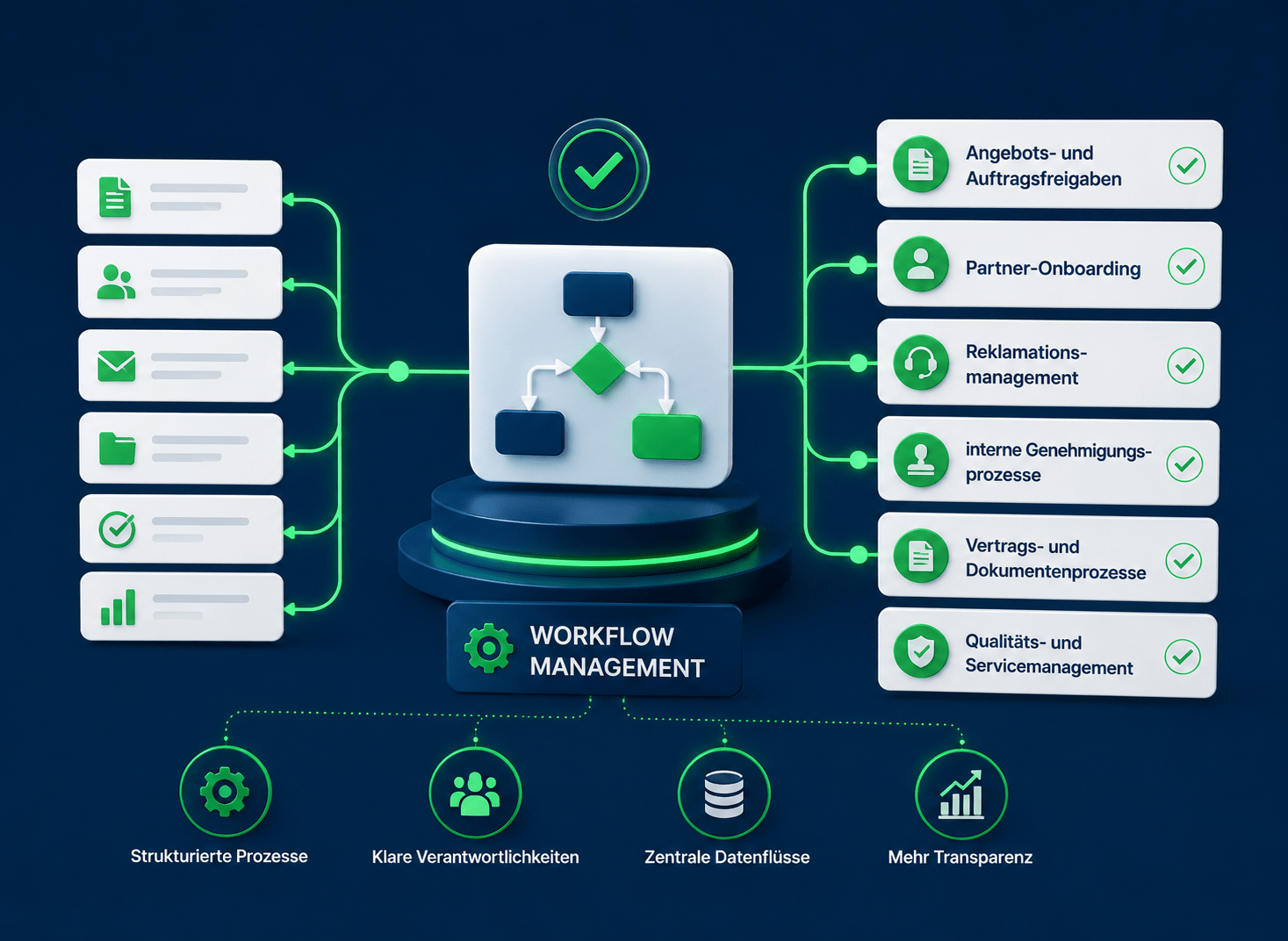
Process automation is one of Creatio’s core areas of application. Companies can reduce manual tasks, clearly define responsibilities, and automatically route information to the right place.
This goes beyond simple approvals or notifications.

With Creatio, even more complex end-to-end processes can be mapped, for example in sales, marketing, customer service, partner management, or internal administrative areas.
The search term “process automation software” therefore describes only a portion of the possible scope of application. Creatio combines technical automation with CRM functions, data management, artificial intelligence, and the development of custom applications.

For companies, this means that processes no longer need to be managed in isolation within different standalone solutions. Instead, data, tasks, and decisions can be interconnected within a single platform.

The ai studio as a central environment for AI agents

The keyword “ai studio” describes one of the most important components of the new release. In Creatio AI Studio, companies can manage the entire lifecycle of an AI agent.
Creatio provides various development tools for this purpose. The Code Agent Designer is intended for complex tasks, while the Prompt Agent Designer creates agents based on natural-language instructions. With the Workflow Agent Designer, multi-stage agents can be modeled visually.
However, for professional use, the technical development of an agent alone is not sufficient. Companies must also clarify:
• What data is the agent allowed to access?
• What decisions is the agent allowed to make independently?
• When is human approval required?
• How are activities and results monitored?
Creatio therefore enhances the development process with governance and observability features. Companies can enforce policies, implement approvals, and track agent execution. Integrations via REST and the Model Context Protocol are also designed to enable connectivity with existing systems and data.

This makes AI Studio a central environment where innovation and control can be combined.

AI Twin, AI Studio, and CRM Agents

Creatio 10x offers a variety of approaches to the use of artificial intelligence. Companies can implement everything from simple personal assistants to complex, controlled, and largely autonomous agents.

AI Twin

AI Twin is designed for individual users. Employees use a dialog-based interface to describe which tasks they want their personal assistant to handle. According to Creatio, this allows users to create their own agents quickly without needing any technical development skills. The agents operate within the access rights and policies specified by the respective company.

Creatio AI Studio

Creatio AI Studio is designed for more complex, hybrid, and autonomous agents. It enables companies to centrally develop, deploy, monitor, and optimize agents.

CRM Agents

In addition, Creatio provides preconfigured and specialized agents for sales, marketing, service, and specific industry processes. These agents can analyze information, create content, or perform defined tasks throughout the customer journey.
Which option makes sense depends on the specific use case. A personal assistant tasked with preparing for a client meeting has different requirements than an autonomous agent that handles service cases or orchestrates marketing campaigns.

The ai studio as a central environment for AI agents

The keyword “ai studio” describes one of the most important components of the new release. In Creatio AI Studio, companies can manage the entire lifecycle of an AI agent.

Creatio provides various development tools for this purpose. The Code Agent Designer is intended for complex tasks, while the Prompt Agent Designer creates agents based on natural language instructions. With the Workflow Agent Designer, multi-step agents can be modeled visually.

However, for professional use, the technical development of an agent alone is not sufficient. Companies must also clarify:
  • What data is the agent allowed to access?
  • What decisions is he allowed to make on his own?
  • When is human approval required?
  • How are activities and results monitored?
Creatio therefore enhances the development process with governance and observability features. Companies can enforce policies, implement approvals, and track agent execution. Integrations via REST and the Model Context Protocol are also designed to enable connectivity with existing systems and data.

This makes AI Studio a central environment where innovation and control can be combined.

What are the benefits of Creatio 10x?

Select a service area for detailed information.

Higher Productivity in Everyday Work

Employees spend a significant portion of their workday on preparatory and administrative tasks. These include searching for information, summarizing processes, or updating data records.
Personal and role-based AI agents can take over or prepare such tasks. This allows employees to access the necessary context more quickly and focus more on consulting, decision-making, and value-adding tasks.
The goal is not to completely replace human employees. Rather, Creatio positions its platform as a collaborative work environment where people and AI agents combine their respective strengths.

Faster development of applications and workflows

Creatio combines AI-powered coding agents with visual no-code tools. This allows applications, data models, user interfaces, and business processes to be created and customized more quickly.
A specialized no-code agency helps companies select suitable processes and transform them into scalable applications. The search term “no-code agency” also frequently leads to service providers that offer visual development. However, it is crucial to consider not only platform operation but also process architecture, integration, and governance.
Creatio Studio offers, among other things, visual tools for user interfaces, data models, workflows, integrations, as well as reports and dashboards. Additionally, applications can be created and expanded using natural language and AI-powered development features.

New Opportunities for Marketing, Sales, and Service

Creatio 10x expands the CRM product suite across all key areas of the customer journey.
In sales, features include AI-powered contact sequences, guided selling, advanced revenue forecasting, and field service capabilities. In marketing, agents can create target audiences, generate content for landing pages, emails, and forms, and orchestrate campaigns. In service, new features for web chat, text, video, and omnichannel communication have been added.
For a CRM marketing agency in Germany, this opens up the possibility of more closely integrating campaign planning, CRM data, and lead processes. Marketing activities can not only be created more quickly but also integrated directly into downstream sales and service processes.

Consolidation of the System Landscape

Many companies use separate systems for sales, marketing, customer service, workflows, and specialized applications. This results in interfaces, media breaks, and inconsistent data sets.
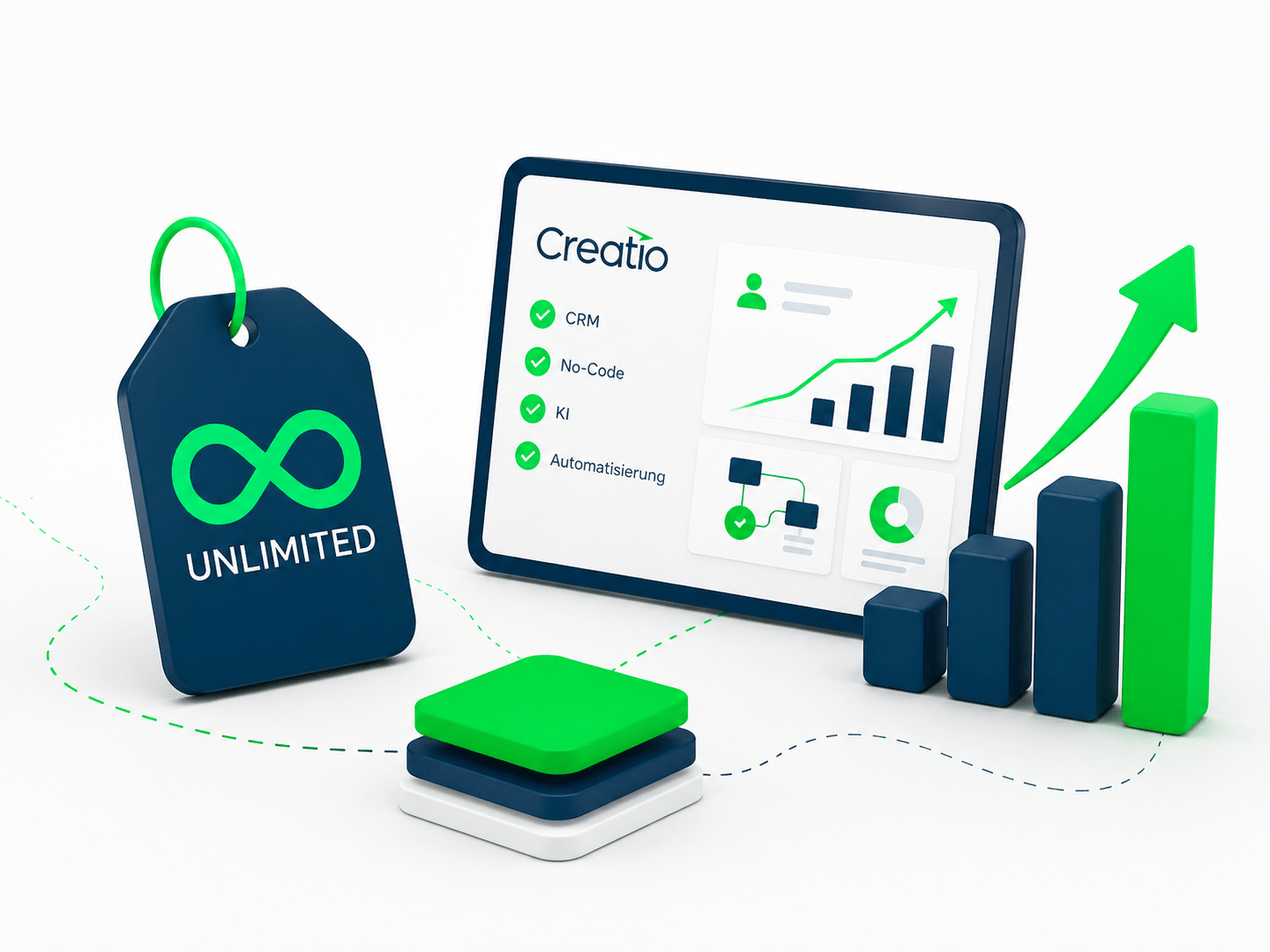
With 10x, Creatio takes the approach of bringing together CRM functions, AI agents, applications, and workflows on a shared AI-native platform.

When is Creatio 10x particularly worthwhile?

Creatio 10x is particularly appealing to companies that no longer want to view CRM, process automation, and AI as separate initiatives.

A typical scenario involves a company that wants to consolidate sales, marketing, and service on a shared data foundation. AI agents can help prepare information, suggest next steps, or perform standardized tasks.

Companies with many custom applications and workflows can also benefit. Thanks to no-code and AI-powered development, line-of-business applications can be deployed more quickly and adapted to new requirements.
The search for a CRM agency in Stuttgart, a CRM agency in Munich, or a CRM agency in Frankfurt should therefore not be based solely on regional criteria. When implementing Creatio company-wide, proven platform expertise, experience with B2B processes, and a robust project methodology are more important than geographical proximity.

What are the benefits of the new pricing model?

Company-wide Use

In many companies, only a limited portion of the workforce actively uses the CRM. Other departments continue to use spreadsheets, emails, or additional line-of-business applications.
An unlimited user model can make it easier to integrate additional departments into a central platform. This transforms Creatio not only into a sales tool, but also into a company-wide process platform.
Scaling Successful AI and Automation Projects

Many companies start with individual pilot projects. For example, an AI agent might assist the sales team with lead qualification or help customer service analyze inquiries.
Once a pilot project is successful, it’s often rolled out to other teams or locations. The Unlimited Plan can help integrate additional users, workflows, and agents without having to go through a completely new licensing process for each expansion.

A Short Checklist for Businesses

Before introducing the new features, four key areas should be evaluated:

1. Use case - What specific task should an AI agent perform?

2. Data - Are the required CRM and process data complete and up to date?

3. Control - What decisions is the agent allowed to make independently?

4. Cost-Effectiveness - What measurable improvements should be achieved?

This concise analysis provides a solid foundation for prioritizing initial pilot projects and further scaling.

Does “Unlimited” automatically mean lower costs?

No. Unlimited usage does not automatically mean that the plan is more cost-effective for every company.
A company with few users and a clearly defined CRM process may be better served by a Growth or Enterprise plan.
The Unlimited plan becomes particularly attractive when:

• many employees and departments are to be involved,
• numerous applications and workflows are planned,
• AI agents are used company-wide,
• Creatio is to be established as the central platform in the long term.

For a well-founded evaluation, companies should consider more than just licensing costs. Implementation, data migration, integrations, training, operation, and further development are also part of the total cost of ownership.
These costs are offset by potential savings, such as shorter process runtimes, fewer manual tasks, and a reduced number of standalone solutions.

Does “10x” automatically mean results that are ten times better?


No. The term “10x” should be understood as a strategic goal and not as a guaranteed performance metric for every company.

Whether a significant increase in productivity is achieved depends primarily on which processes are selected. A highly manual, standardized workflow usually offers greater potential for automation than a rare and highly customized process.
Other important factors include the quality of CRM data, employee acceptance, and integration with existing systems. AI agents also require clear rules and a reliable technical foundation.
Companies should therefore evaluate success based on specific metrics. These may include shorter processing times, higher conversion rates, lower error rates, or improved customer service availability.

Those looking to automate customer service should, for example, measure more than just the number of automatically answered inquiries. Equally relevant are the resolution rate, customer satisfaction, handoff quality, and processing time for complex cases.

Classification of MPowerdHub

From MPowerdHub's perspective, Creatio is 10 times more than a traditional software update.
This release demonstrates how CRM, no-code development, process automation, and artificial intelligence are converging into a unified enterprise platform. However, business value does not come solely from the introduction of new features.

Which processes should be automated, and how can people, applications, and AI agents work together effectively in this context?

MPowerdHub supports B2B companies with CRM implementations, process automation, and digital transformation. Its approach combines strategic consulting with operational implementation and includes, among other things, process analysis, CRM implementation, no-code/low-code workflows, and the long-term development of digital solutions.
With Creatio 10x, MPowerdHub helps companies identify suitable AI use cases, analyze existing CRM processes, and develop a phased implementation strategy.
This includes configuring the platform, integrating existing systems, developing custom workflows, and defining appropriate roles, permissions, and control mechanisms.

Creatio 10x combines CRM, AI, and no-code on a single platform

With Creatio 10x, Creatio is consistently advancing its CRM and workflow platform for the era of agent-based business processes.

Personal assistants via AI Twin, complex agents in Creatio AI Studio, and new features for sales, marketing, and service are designed to help companies complete tasks faster and automate processes more effectively.
Particularly relevant is the combination of AI agents, visual no-code development, and enterprise-wide governance. This enables both business units and IT teams to contribute to the development of new applications and automations.
However, the term “10x” should not be interpreted as an automatic guarantee of success. The actual added value depends on the selected processes, data quality, integration, and a structured implementation.
MPowerdHub helps companies realistically assess the capabilities of Creatio 10x and use that assessment to develop a viable CRM, AI, and automation strategy.

Talk to the Creatio experts at MPowerdHub. Together, we’ll analyze your processes, data, automation goals, and potential use cases for AI agents.

Frequently Asked Questions About Creatio 10x

Creatio 10x is a release of the Creatio platform announced on July 15, 2026. It combines AI Twin, Creatio AI Studio, no-code development, and advanced CRM features for sales, marketing, and customer service.

AI Twin is a personal AI assistant for individual users. Employees can use a dialog-based interface to describe which tasks the agent should handle. The agents operate within the access rights and policies defined by the company.

Creatio AI Studio is used to develop, deploy, and manage complex AI agents. It offers tools for prompt-based, workflow-based, and code-based agents, as well as features for integration, governance, and monitoring.

Creatio 10x is particularly well-suited for medium-sized and larger companies that want to integrate CRM, AI agents, and process automation on a single platform. This release is especially relevant for organizations with a large number of users, complex customer processes, or a growing number of custom applications and workflows.

MPowerdHub analyzes existing CRM and business processes, prioritizes suitable AI use cases, and supports the technical implementation. This includes the implementation, integration, workflow development, and long-term enhancement of the Creatio platform.
30 minutes. No sales pitch. Just an open conversation about the challenges you face.
© 2026 MPoweredHub GmbH All rights reserved.
Made by komenci