Workflow Automation: Which Processes Should Companies Automate Today?
Manual processes take time, create opportunities for error, and hinder scalability. This is exactly where workflow automation comes in: Recurring tasks are carried out digitally according to clear rules, information is automatically forwarded, and employees are involved only when a decision or expert assessment is required. This is particularly relevant for B2B companies, as sales, marketing, customer service, and internal approvals often involve collaboration across multiple systems.
Search queries such as “workflow automation,” “automation workflow,” or “process automation” show that companies aren’t just looking for software. Above all, they want to know which processes can be automated in a way that makes economic sense. The best starting point is recurring, rule-based, and data-driven processes with clear responsibilities.
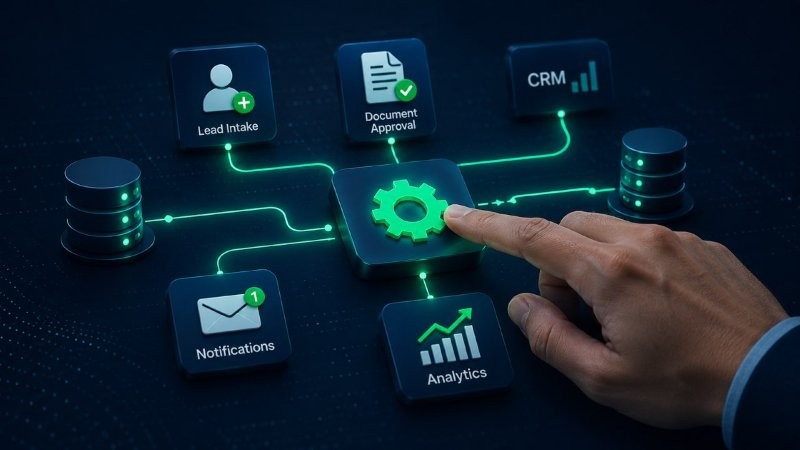
Workflow automation means that defined work steps are automatically triggered, controlled, and documented by software. One event triggers the next step: a new lead generates a sales task, a quote approval notifies the responsible decision-maker, or a service case is routed to the appropriate team based on priority and customer group. People searching for “process automation definition” often have an even more comprehensive approach in mind. Process automation doesn’t just look at a single workflow; it can connect an entire end-to-end process across multiple departments and systems. Suitable workflow automation software digitally maps out the rules, statuses, responsibilities, and handoffs for this purpose.
Which processes should companies automate first?
Not every workflow is equally suitable. Processes that occur frequently, require little discretion, and currently involve a lot of manual data entry or follow-up inquiries are particularly attractive.
• Lead distribution and sales follow-ups • Quotation, discount, and order approvals • Customer and employee onboarding • Service tickets, escalations, and status updates • Appointment confirmations and reminders • Data transfers between CRM, ERP, and other systems • Document, invoice, and approval processes
For companies looking to automate their processes, a manageable first step usually makes more sense than a large-scale transformation project. A clearly defined, high-volume workflow quickly reveals whether processing time, error rates, or manual effort are decreasing measurably.
What are the benefits of workflow automation?
The benefits of workflow automation go far beyond mere time savings. Automated workflows create a more reliable process structure: tasks aren’t forgotten, data is processed more consistently, and responsibilities remain traceable.
The benefits of process automation also become particularly apparent as a process grows. As the number of leads, orders, or service cases increases, the administrative workload doesn’t have to increase at the same rate. This improves scalability and relieves teams of repetitive tasks.
Workflow Automation in CRM and IT
The potential for workflow automation in CRM is particularly significant. CRM systems already contain a wealth of information needed for automated processes: contacts, companies, leads, opportunities, activities, and service cases. This allows sales tasks, follow-ups, approvals, or escalations to be triggered directly within the customer context.
In the area of “IT process automation,” the focus is often on cross-system workflows. Here, applications, interfaces, and data flows must work together seamlessly. The more closely CRM, ERP, e-commerce, service, and document management are integrated, the more important it becomes to have clean technical orchestration.
AI Process Automation: How Is Artificial Intelligence Changing Things?
Traditional automation operates according to fixed rules. Artificial intelligence expands on this approach by adding the ability to interpret content, classify information, and prepare the next steps. Search terms such as “process automation AI” and “AI process automation” therefore represent a trend in which rule-based workflows and intelligent decision-making are converging.
For example, an AI agent can analyze a customer inquiry, identify the issue, compile relevant CRM information, and assign the case to the appropriate process. For clear-cut, standard cases, the process can be largely automated. In cases of exceptions or business-critical decisions, a human remains involved.
Which tools are suitable for process automation?
The selection of suitable process automation tools should always be based on the process itself, rather than on the longest possible list of features. Depending on the use case, CRM platforms, no-code and low-code solutions, integration platforms, or specialized workflow automation tools may be appropriate.
In more complex system landscapes, workflow orchestration and powerful workflow automation software also play an important role. They ensure that individual automations do not become isolated silos, but rather that data and process steps are coordinated across multiple systems.
Before selecting a tool, companies should therefore clarify which systems are involved, what data is exchanged, which decisions can be automated, and at which points human approval is intentionally required.
How to Get Started with Workflow Automation
A good automation project doesn’t start with technology, but with a clear picture of the process. If you digitize a poor process without changing it, you’ll end up with nothing more than a poor process that runs faster.
1. Select a process: Prioritize a frequent and clearly structured workflow. 2. Map the current process: Document steps, responsibilities, data, and systems. 3. Determine automation potential: Separate rule-based tasks from business decisions. 4. Measure success: Define key metrics such as processing time, error rate, turnaround time, or manual effort.
Consulting on process automation is particularly valuable when multiple departments, systems, or data sources are involved. When searching for a company to handle workflow automation, B2B decision-makers should therefore focus not only on technical implementation but also on process expertise, integration knowledge, and the ability to assess the economic benefits in advance.
Quick Checklist: Is a Process Suitable for Automation?
A process generally has good potential if several of the following points apply:
• The process is repeated frequently. • The process steps largely follow clear rules. • Data is currently transferred multiple times or manually. • Errors, delays, or follow-up inquiries occur regularly. • Multiple employees or systems handle the same transaction. • The volume is expected to grow without proportionally increasing the administrative burden.
Classification of MPowerdHub
From MPowerdHub’s perspective, process automation should never be viewed as an isolated IT project. The greatest benefits are realized when business processes, CRM, data, and integrations are planned together. That’s why sustainable automation doesn’t start with a tool, but with the question of which processes actually need to be improved.
MPowerdHub supports B2B companies from process analysis through CRM and no-code/low-code solutions to technical integration and further development. The focus is not on the maximum number of automated workflows, but on measurable benefits: less manual work, better data quality, shorter turnaround times, and processes that scale with the company.
Improve the process first, then automate it
Workflow automation can make B2B companies significantly more efficient and scalable. Recurring, rule-based, and data-intensive processes in sales, marketing, customer service, and administration are particularly well-suited for automation. With CRM, no-code, low-code, and AI, even more complex process chains can now be intelligently supported.
However, the key success factor remains selecting the right process. Companies should therefore not ask what can be automated from a technical standpoint, but rather which automation delivers the greatest measurable business value. Would you like to find out which processes in your company have the greatest potential for automation?
MPowerdHub works with you to analyze existing processes and develop a concrete roadmap for workflow, CRM, and process automation.
Frequently Asked Questions About Creatio 10x
Workflow automation means that recurring tasks within a defined process are automatically triggered, executed, and documented. Rules, data, or events determine the next step in the process.
Frequently recurring, rule-based, and data-intensive processes are particularly well-suited. Typical examples include lead distribution, approvals, onboarding, service tickets, reminders, and data transfer between different systems.
Workflow automation often focuses on a specific sequence of steps. Process automation, on the other hand, tends to look at the entire end-to-end process and can connect multiple workflows, departments, and systems.
AI can analyze unstructured information, classify content, and prepare decisions. The combination of fixed workflow rules and AI-powered processing is particularly effective for tasks that cannot be fully mapped by simple if-then rules.
The best place to start is with a clearly defined process that is highly repetitive and involves a measurable amount of manual effort. Next, the current process is documented, unnecessary steps are eliminated, the potential for automation is assessed, and clear key performance indicators are defined.
30 minutes. No sales pitch. Just an open conversation about the challenges you face.
Your specialized B2B digital platform consultancy. CRM implementation, process automation, and digital transformation—with fixed prices and a team that delivers.