MPoweredHub logo with blue-green lettering and a curved blue line.
Reading time: about 15 minutes

Custom Software Development or Low-Code? A Comparison of Costs, TCO, and Speed

When it comes to new digital applications, companies often face the same fundamental question: Should a solution be custom-developed, or can the goal be achieved more quickly and cost-effectively using a low-code platform? Both approaches have their merits. The key factor is which approach better aligns with the company’s processes, budget, timeline, and long-term IT strategy.
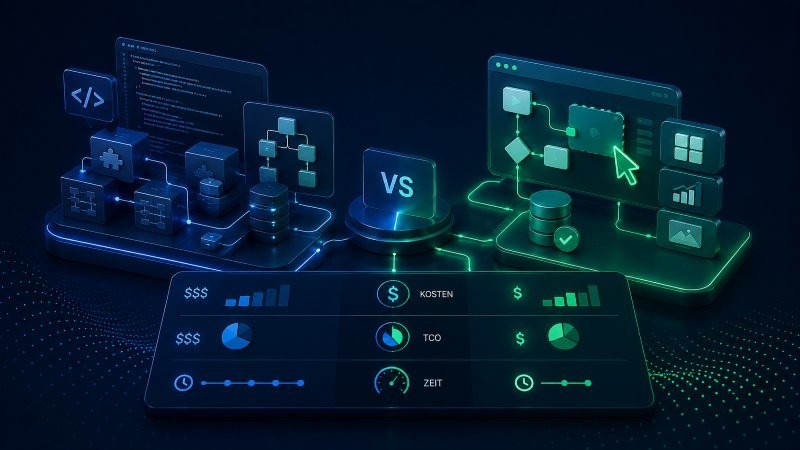
Custom Software Development vs. Low-Code

Comparison of Costs, TCO, and Speed

Custom software development offers maximum flexibility. Features, data models, and user interfaces can be tailored precisely to specific requirements. Low-code, on the other hand, takes a different approach: applications and workflows are built using visual building blocks, pre-built components, and significantly less traditional programming.

For B2B companies, therefore, the decision should not be based solely on initial development costs. Only a TCO analysis can reveal which solution is more cost-effective over several years. Equally important are implementation speed, adaptability, integrations, maintenance, and the question of how quickly new requirements can be implemented later on.

What does custom software development mean?

Custom software development means that an application is specifically designed and programmed to meet a company’s requirements. Unlike off-the-shelf software, the solution is not based on a predefined set of features, but rather on the company’s specific business processes.

Put simply, software development can be summarized as follows: requirements are gathered, the application is designed from both a business and technical perspective, programmed, tested, and then deployed. This approach offers a high degree of flexibility but typically requires more time, budget, and a sustained supply of development expertise.

Custom software development is particularly useful when a company has very specific processes that are difficult to implement using off-the-shelf or platform-based solutions, or when the software itself is a strategic competitive advantage.

How is low-code changing things?

Low-code reduces the amount of traditional programming. A low-code platform provides visual editors, data models, workflow building blocks, and integration options. This allows applications to be created and customized more quickly.

Low-code development is particularly useful when business units and IT need to collaborate more closely. Requirements can be prototyped more quickly and then expanded step by step. A low-code application builder can help build user interfaces, processes, and data objects within a shared environment.
Low-code accelerates the development of digital applications
No-code also plays a role in this context. A no-code platform or no-code application is typically designed for more standardized use cases. When comparing low-code and no-code, low-code generally offers greater technical flexibility and is therefore more often suitable for more complex B2B scenarios.

Compare Costs: Don't Just Look at the Project Price

The project cost alone is only one part of the economic analysis. Custom software development typically involves costs for design, development, testing, documentation, hosting, maintenance, and future modifications. With low-code solutions, platform and licensing costs are added, but development effort is often reduced.

A robust TCO calculation therefore takes into account not only the initial implementation but also the total costs over the planned period of use. This is precisely where the TCO analysis provides the most important basis for decision-making.

With a custom solution, lower ongoing licensing costs may be offset by higher development and maintenance costs. With low-code, the opposite is possible: higher platform costs, but significantly shorter development times and less effort required for customizations. Which option is more cost-effective depends on the specific use case.

• Initial development or implementation
• Platform and licensing costs
• Maintenance, updates, and technical operations
• Integrations and data migration
• Effort required for future changes
• Internal resources and external service providers
TCO and ROI Analysis for Software Development and Low-Code Platforms

TCO and ROI: Two Key Metrics for Better Decision-Making

Total Cost of Ownership and Return on Investment examine the same investment from different perspectives. TCO shows what a solution actually costs over its lifecycle. ROI, on the other hand, evaluates the economic benefits that offset these costs.
Therefore, calculating ROI requires more than just project costs. Time saved, faster processing times, lower error rates, and additional revenue can also be taken into account. The ROI formula thus becomes an important tool for aligning technology decisions with business benefits.

ROI is particularly relevant in the context of low-code because the benefits often stem from speed and flexibility. When a company can put new processes into production significantly sooner, it gains a financial advantage that wouldn’t be apparent if license costs were the only factor considered.

Practical Tip: Don’t just compare project prices. What matters most is which solution requires less effort over three to five years and delivers measurable benefits more quickly.

Speed: Where Low-Code Really Shines

When it comes to implementation speed, low-code has a structural advantage. Many technical foundations are already in place. Data models, forms, user permissions, and workflows do not always have to be programmed from scratch.

As a result, low-code development can significantly shorten the time from initial concept to production deployment. This is particularly valuable when requirements change regularly or a company wants to digitize multiple processes.

Custom software development remains a viable option, however, when specific technical requirements, very high performance demands, or unique features are the focus. Speed alone should therefore not be the sole selection criterion.

When is custom software development the right choice?

A custom solution can be particularly beneficial if several of the following points apply:

• The process is highly specific and cannot be adequately modeled using standard components.
• The software itself is a central component of the business model.
• There are very high requirements for performance or technical architecture.
• Full control over source code and technical development is strategically important.
• The company has sufficient development resources available on an ongoing basis.

When is a low-code platform the right choice?

Low-code solutions are often particularly appealing when speed, adaptability, and process automation are the top priorities:

• Multiple applications or workflows are to be digitized in stages.
• Business units should be more closely involved in development.
• Processes change regularly and must be adapted quickly.
• Integrations, data models, and automations should converge on a single platform.
• Development effort should be reduced without sacrificing customization.

Low-code automation as an added benefit

Low-code automation extends the benefits of a platform beyond mere app development. Companies can integrate approvals, tasks, notifications, and data flows directly into digital processes.

This creates a key difference from traditional project logic:
An application isn’t developed just once; instead, it can be continuously refined. Low-code and no-code tools help test and optimize processes more quickly.

This is particularly interesting for mid-sized B2B companies, as their requirements often grow over time. What starts out as a single specialized application can later be expanded to include CRM processes, portals, integrations, or additional workflows.

How Companies Make the Right Decision

The choice between custom software development and low-code should always be based on the specific business case. This includes a clear description of the desired process, user groups, integrations, and expected developments in the coming years.

Companies should then compare both approaches using consistent criteria. In addition to cost and speed, these criteria include scalability, security, maintainability, flexibility, and internal resources.

A hybrid approach can also be a sensible option. Critical or highly customized components are developed using traditional methods, while standard processes and line-of-business applications are implemented using low-code solutions. This allows for a combination of flexibility and speed.

Recommended decision-making questions:

• How customized is the business process, really?
• How quickly does the solution need to go live?
• How often will requirements change?
• What integrations are required?
• What are the TCO and expected ROI over several years?
• What development and operational resources are available internally?

Classification of MPowerdHub

From MPowerdHub’s perspective, there is no single technology that is universally better. The right decision depends on how unique a process is, how quickly results are needed, and what requirements will arise in the long term.
MPowerdHub helps B2B companies evaluate software strategies, low-code platforms, and automation scenarios. In doing so, we consider not only technical features but also TCO, ROI, integration effort, governance, and scalability.

The goal is a solution that not only works technically but also makes economic sense and can be further developed over the long term.

Low-code and custom development are not mutually exclusive

Custom software development offers maximum flexibility, but in many cases it is more time- and resource-intensive. Low-code solutions can make applications, workflows, and process automation available much more quickly and often reduce development effort.

A sound decision can only be made when companies consider costs, TCO, ROI, speed, and long-term requirements together. In many cases, the best solution isn’t the most technically complex one, but rather the one that offers the best balance of benefits, flexibility, and overall effort.

Would you like to determine whether custom development, low-code, or a hybrid approach makes the most sense for your project? MPowerdHub works with you to analyze requirements, TCO, and implementation options, and uses this information to develop a robust software and automation strategy.


FAQ – Frequently Asked Questions About Choosing a CRM

There is no one-size-fits-all answer to this question. Low-code solutions often reduce development time and customization efforts, but they also incur platform costs. A TCO analysis spanning several years is therefore more meaningful than the project price alone.

This is especially true for highly specialized processes, situations involving high technical requirements, or when the software is a strategic component of the business model.

Low-code enables faster development, easier customization, and greater collaboration between business units and IT. In addition, workflows and automations can often be integrated directly.

Very important. ROI shows whether the economic benefits of a solution justify the investment. These benefits include not only revenue but also time savings, process quality, and reduced manual effort.

MPowerdHub evaluates requirements, TCO, ROI, integrations, and scalability, and uses this information to develop a recommendation for custom development, low-code, or a hybrid approach.
30 minutes. No sales pitch. Just an open conversation about the challenges you face.
© 2026 MPoweredHub GmbH All rights reserved.
Made by komenci