MPoweredHub logo with blue-green lettering and a curved blue line.
Reading time: about 15 minutes

Choosing a CRM System: Which CRM Is Really Right for B2B Companies?

Today, a CRM system is much more than just a digital contact list. For B2B companies, it is becoming the central platform for sales, marketing, customer service, and business processes. That is precisely why choosing a CRM system is not just a software decision, but a strategic choice that sets the course for growth, efficiency, and customer experience.
CRM Selection in B2B with a Focus on Processes, Data, Integration, and Scalability

Choosing a CRM System: Which CRM Is Really Right for B2B Companies?

Many companies start by searching for terms like “CRM system,” “CRM software,” or “CRM tools” and comparing features. That makes sense—but it’s not enough on its own. After all, even the best tool is of little use if it doesn’t align with a company’s own workflows, goals, and teams. To successfully implement customer relationship management, you need to consider processes, data, integration, user-friendliness, and scalability as a whole.

This article shows how B2B companies can systematically select a CRM system, which criteria really matter, and what’s important during implementation. At the same time, MPowerdHub explains how modern CRM software, CRM integration, workflow automation in CRM, and artificial intelligence in CRM can be effectively combined.

Why Choosing the Right CRM System Is So Important

Anyone wondering what CRM systems are often finds very general answers. In practice, however, there is much more at stake for companies: A CRM management system must support sales, make marketing data actionable, map service processes, and create a reliable database.
A suitable CRM system improves transparency in sales, shortens response times, facilitates collaboration between teams, and provides a better foundation for decision-making. An unsuitable system, on the other hand, often leads to data silos, low adoption rates, and duplicate work.

• A CRM system consolidates customer, contact, and activity data in one place.
• It supports sales, marketing, and service with clear processes.
• It creates a foundation for automation, reporting, and CRM integration.
• It must be a good fit for the business—not just look good functionally.
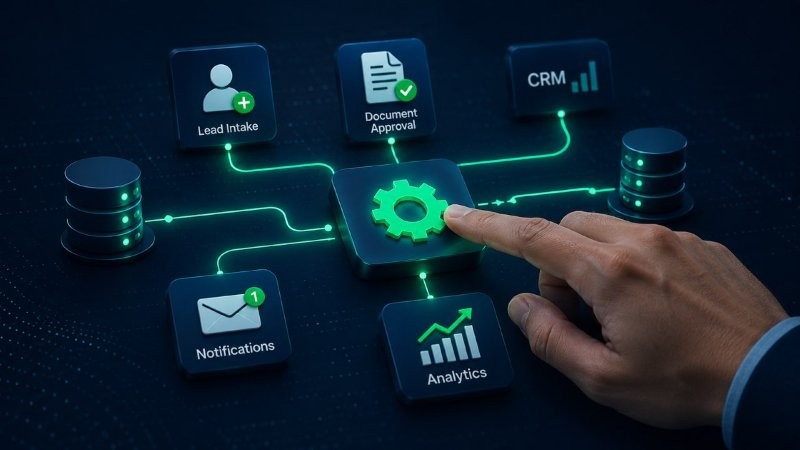
Digital workflow with automated approvals and CRM steps
That is why the definition of a CRM system in B2B should not be understood solely in technical terms. A modern customer relationship management platform is a central tool for managing customer processes and a key component of CRM digitization.

The Five Most Important Criteria for Choosing a CRM System
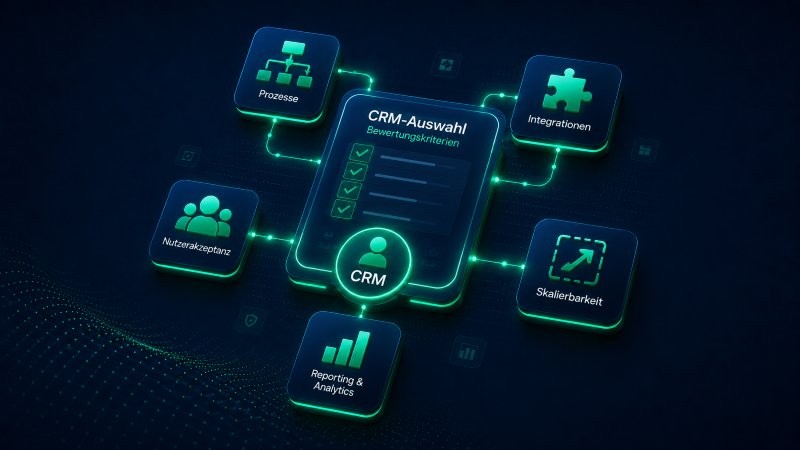
Five Key Criteria for a Structured CRM Selection Process in B2B

1. Clarify Objectives and Use Cases

Before a company compares CRM software solutions, it must be clear what tasks the system is intended to perform. Is the primary focus on sales management, lead management, customer relationship management in customer service, or an integrated platform for multiple areas? Only once the objectives are clear can a company assess which CRM software is truly the right fit.

2. Evaluate processes rather than just functions

Many companies initially focus only on comparing feature lists. What really matters, however, is how well the solution supports real-world workflows. A CRM program must be able to accurately map out quotation processes, lead handoffs, task management, customer documentation, and, where applicable, workflow automation within the CRM.

3. Review the data structure and CRM integration

A good CRM system must integrate seamlessly into the existing system landscape. This includes email, ERP, marketing platforms, web forms, and service tools. Without proper CRM integration, data silos can quickly form. A consistent database is crucial, especially in B2B customer relationship management.

4. Consider user-friendliness and acceptance

Even powerful customer relationship management tools fail if they aren't used in day-to-day operations. That's why the solution should be clear, easy to understand, and practical. For sales and service teams, what matters most is how quickly information can be found and how intuitively processes can be documented.

5. Plan for Scalability, Support, and Future Development

A CRM system should not only meet today’s needs. It must grow with the company, accommodate additional users, and be adaptable to new requirements. Equally important are CRM support, clear governance, and the ability to later expand the system to include automation, reporting, or artificial intelligence.

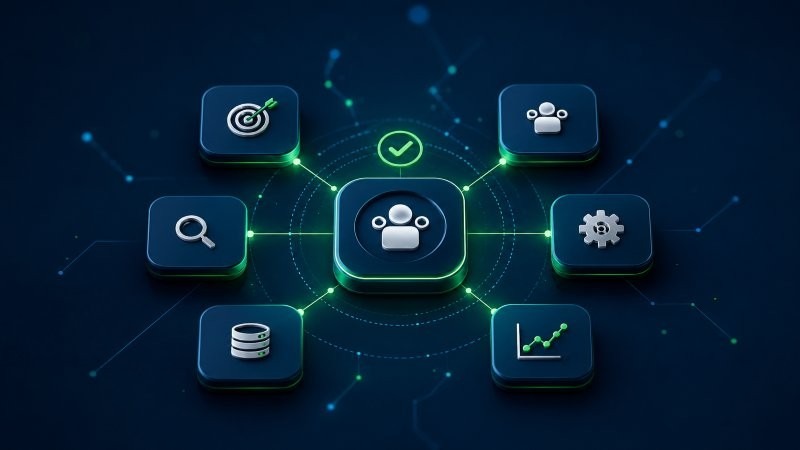
A CRM system integrates sales, marketing, customer service, data, and automation

Common Mistakes When Choosing CRM Software

A common mistake is to choose a CRM system based solely on price or brand recognition. Free CRM software, free CRM systems, or a free CRM system may be appropriate in some cases—but for many B2B companies, such solutions are not sufficient in the long run as processes become more complex or multiple teams collaborate.
Another mistake is approaching the implementation from too technical a perspective. Customer Relationship Management (CRM) software is then viewed as an IT project, even though the focus should actually be on sales and customer processes.

Finally, the importance of data migration, role-based logic, training, and change management is often underestimated. A CRM can only be successful if people use it properly and the company’s processes are aligned with it.

• Comparing features without defining specific use cases.
• Choosing a system that doesn’t fit the processes or data structures.
• Considering CRM integration and future scalability too late.
• Underestimating user acceptance and the implementation strategy.

Here's How B2B Companies Can Make a Smart Choice When Selecting a CRM

A structured selection process does not begin with a product demo, but rather with an internal assessment.

Companies should first define the goals they wish to achieve with the CRM system. These include, for example, better lead quality, greater transparency in sales, faster response times in customer service, or the standardization of customer processes.

The second step involves identifying the relevant requirements. The teams involved should be actively engaged in this process. Sales, marketing, customer service, and management often have different perspectives, which directly impact how the system is used later on.

Next, suitable CRM tools and CRM software solutions can be evaluated. It is important here to have a clear evaluation framework with mandatory criteria, desired criteria, and future requirements. This transforms a general question like “What are CRM systems?” into a solid basis for decision-making for your own company.

Recommended Process:
• Define goals and business cases
• Map current processes and the data landscape
• Prioritize requirements
• Create a shortlist of suitable CRM systems
• Conduct demos, tests, and a fit-gap analysis
• Plan implementation, CRM support, and further development

What Modern CRM Systems Should Also Be Able to Do Today

A modern CRM system is more than just a database. It should manage activities, automate processes, and improve collaboration between teams. That’s why topics such as customer relationship management platforms, customer relationship management software, CRM integration, and data quality are particularly relevant today.

No-code and low-code features are also becoming increasingly important, enabling companies to adapt their workflows more quickly. Artificial intelligence in CRM is also playing a growing role—for example, in lead scoring, sales recommendations, data enrichment, or automated next steps.

For midsize companies, this means that the right CRM software should not be overly complex but should be future-proof. It must meet today’s needs while also enabling future growth.

Classification of MPowerdHub

From MPowerdHub’s perspective, choosing a CRM is always a business decision. It’s not the solution with the longest list of features that wins, but the one that connects processes, teams, and data in the most meaningful way. Companies benefit the most when CRM strategy, implementation, integration, and future development are considered as a unified whole.

MPowerdHub supports B2B companies in analyzing their requirements, selecting suitable CRM systems, handling technical implementation, and providing CRM support after go-live. By combining CRM, process automation, and digital transformation, the result is not a siloed solution, but a robust platform for sustainable growth.

Practical Tip: A good CRM system should be selected so that it delivers quick results today and can grow with the company tomorrow.

The right CRM system fits your processes—not just a checklist

There are many CRM systems, CRM software solutions, and customer relationship management tools available. What matters isn’t which system is the most well-known in general, but which one delivers the greatest business value for your company.

By taking goals, processes, data, integration, user requirements, and future development into account from the very beginning, you can significantly reduce the risk of making the wrong decisions. This is exactly how the search for a CRM system becomes a sound B2B decision.

Want to find out which CRM system is truly the right fit for your company? MPowerdHub supports you in selection, implementation, CRM integration, and further development—strategically, technically, and operationally.

FAQ – Frequently Asked Questions About Choosing a CRM

A CRM system is software used to manage customer relationships, sales opportunities, contacts, activities, and often marketing and service processes as well. In the B2B sector, it serves as a central platform for structured customer management.

Key factors include objectives, processes, data structure, integrations, user-friendliness, scalability, and support. A good CRM selection is based not only on features but also on real-world business needs.

That depends on the specific use case. For simple needs, a free solution may be sufficient. However, as soon as multiple teams, more complex processes, or integrations are required, free CRM systems often reach their limits.

A very big one. Without CRM integration, data silos and duplicate data entry result. A good CRM should integrate seamlessly with email, ERP, marketing, and service systems.

MPowerdHub analyzes requirements and processes, creates a structured selection framework, guides the system evaluation, and subsequently provides support for implementation, CRM support, and further development.
30 minutes. No sales pitch. Just an open conversation about the challenges you face.
© 2026 MPoweredHub GmbH All rights reserved.
Made by komenci